

Governance in Healthcare. Not a Policy Document, But an Operational Culture.
Why rushing to be ‘compliant’ right before an audit is the wrong approach to governance in healthcare.
The Compliance Landscape is Changing
Governance is often associated with the big green tick after an audit. However, just because you were compliant when the auditors came does not mean governance is embedded throughout your organisation.
In todays environment, organisations are increasingly expected to demonstrate how decisions are made, risks are managed and that quality is monitored continuously. As these expectations rise, governance in the healthcare industry is becoming less about what is documented and more about what your workflows actually look like.
| Good governance is not measured by what is audited. It is measured by how effectively standards are embedded into everyday operations.
Governance Is More Than Policies & Procedures
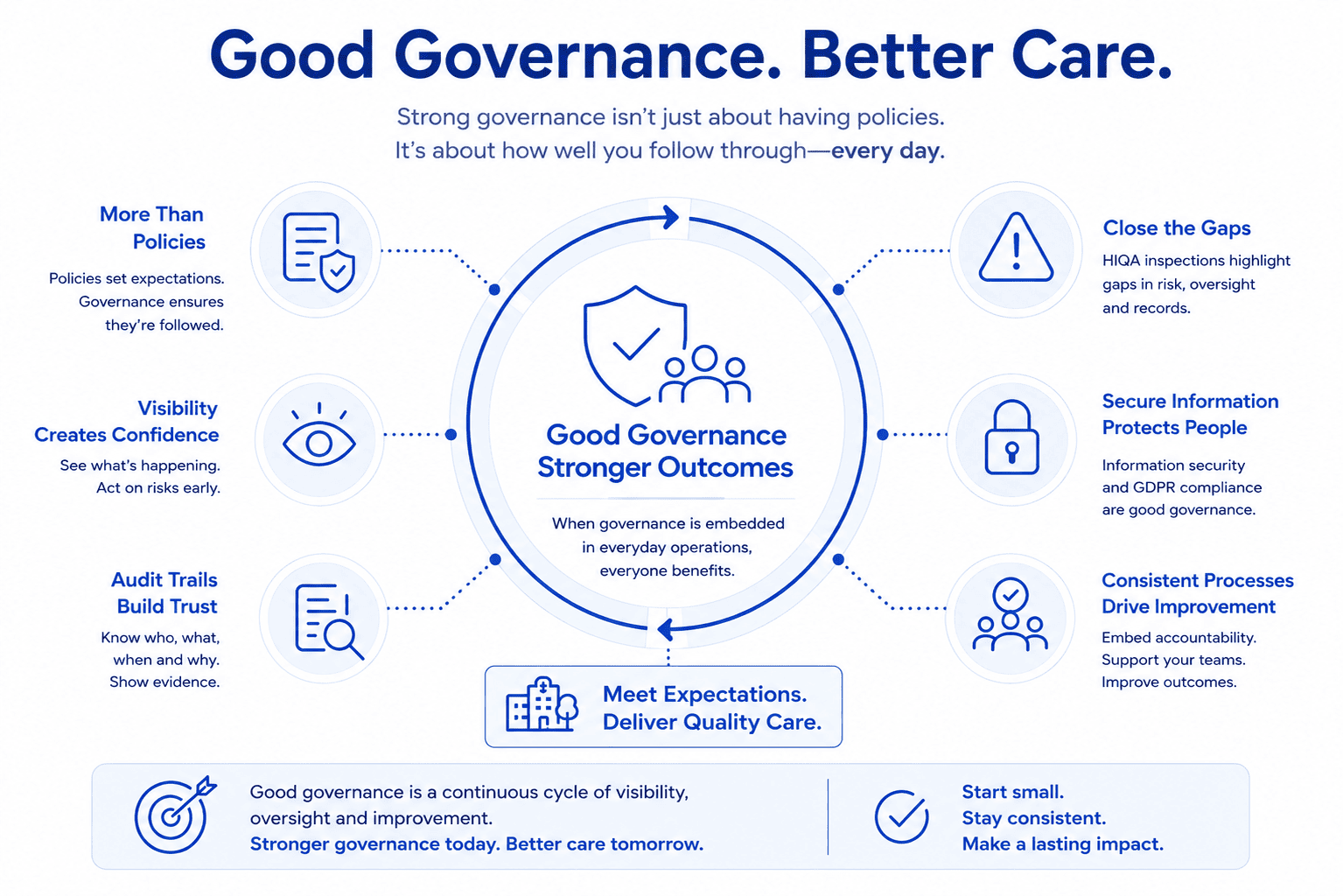
A common misconception is that good governance is having the documentation to demonstrate compliance and the policies required to support best practise. While documentation plays an important role, governance is not measured by what is written down. It is measured by how effectively standards are embedded into everyday operations.
Good governance provides organisations with confidence that processes are being followed, responsibilities are understood, risks are actively managed and quality outcomes are constantly monitored. Not just on paper, but in practise.
Good healthcare governance bridges the gap between policy and practise, ensuring compliance becomes part of daily operations rather than periodically in preparation for an audit.
Where Providers Are Going Wrong
With HIQA regulations evolving, care providers are becoming vulnerable. If providers do not adapt to rising standards, they becoming at risk of not being compliant. HCI studied 25 HIQA inspections, identifying common vulnerabilities that providers are failing on.
The common vulnerabilities that the study found included:
- Governance & Management
- Failing to Identify Real Risk Through Audit Systems
- Lack of Organisational Structure & Accountability
- Fire precautions
- Food & Nutrition
- Staffing, Training & Supervision
All of these areas are becoming heavily scrutinized in HIQA inspections. This ultimately highlights the importance of consistency, accountability and oversight in all care facilities. Providers that are not regularly evaluating their governance and oversight and aligning with HIQA guidelines are becoming more and more vulnerable as standards continue to rise.
Governance Relies on Visibility
Good governance stems from operational visibility. Without it, leaders fail to proactively identify risks, monitor performance and see trends. When information is hidden through multiple systems, different sources and requires lots of navigating, oversight is lost.
Visibility allows organisations to pivot from reactive decision-making to insightful, proactive management of operations. This provides leaders with confidence.
Operational visibility allows organisations to manage accountability. When information is accurate, available and consistently maintained, providers are better positioned to prove compliance. This supports providers to maintain compliance, support quality of care and respond confidently during inspections and in daily operations.
| Providers with effective operational visibility are better positioned to consistently demonstrate compliance
The Importance of Audit Trails & Accountability
Providers with good operational visibility are better off but only solve half of the problem. Visibility enables organisations to understand what is happening across their services, but effective governance also requires the ability to demonstrate compliance, accountability and oversight over time.
Effective governance relies on accountability. Organisations need confidence that actions are not only assigned, but also completed, reviewed, and documented appropriately.
During inspections, providers are often required to demonstrate how incidents were managed, how corrective actions were implemented, and how risks were identified and monitored. Without clear records and comprehensive audit trails, this process can become both difficult and time-consuming.
Audit trails provide transparency by creating a verifiable history of activity. They enable organisations to demonstrate who completed an action, when it occurred, and how issues were addressed. In doing so, they help providers evidence compliance, strengthen accountability, and demonstrate that governance processes are functioning as intended.
Embedding Governance into Everyday Operations
Strong governance is not a result of a last-minute fix up before an inspection. It is built through consistency of service delivery in day-to-day operations.
Organisations that integrate governance into their daily workflows are better positioned to identify risks early, support continuous improvement and demonstrate compliance when required.
Achieving this level of oversight can become increasingly difficult when information is spread across multiple systems and processes vary between teams.
As a result, many providers are looking to centralise key governance activities such as internal audits, risk management, incident reporting, compliance monitoring, and operational oversight to improve visibility and maintain consistency across their organisation.
As expectations from HIQA continue to evolve, governance is becoming less about preparing for inspections and more about creating a culture of accountability, transparency, and quality.
| When governance becomes part of everyday operations, compliance becomes a by-product rather than a goal.